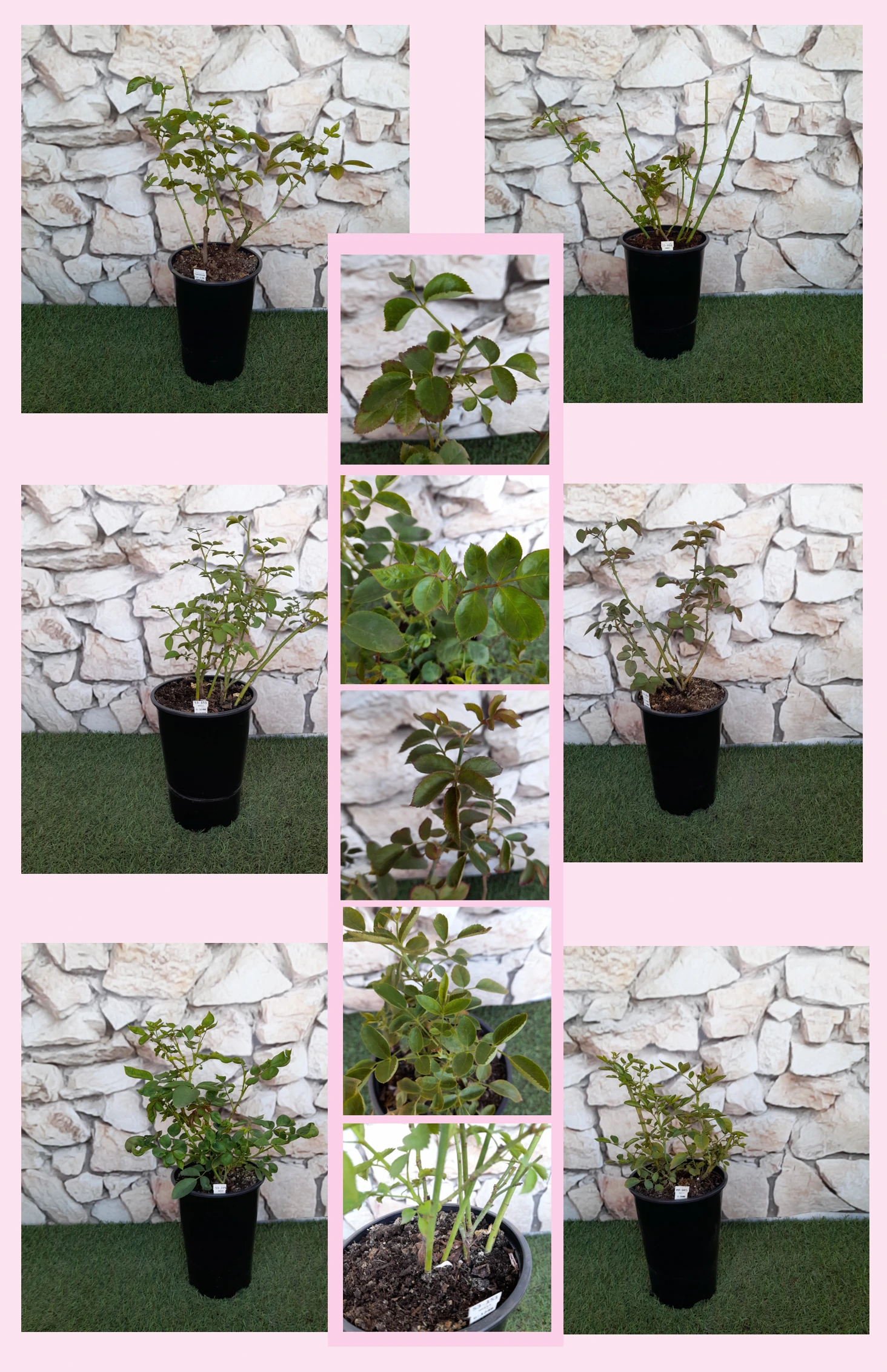
Historical Rose

52-533-1
52-533-2

Veilchenblau

Historic rose

- – Hermann Kiese

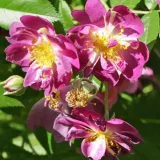
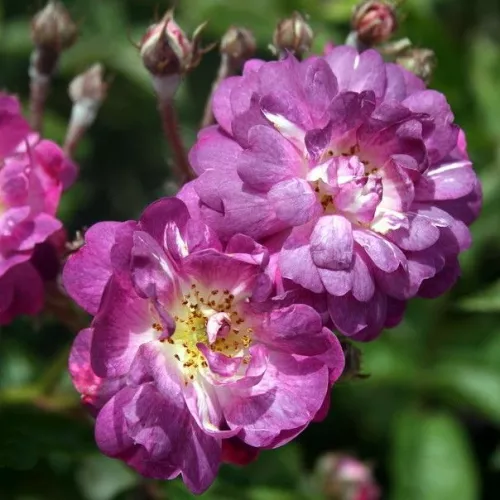
Bright crimson purple shade, paler in the centre. - historic - rambler, climbing - trailing rose - mild, subtle-scented rose - sweetly spicy

Veilchenblau le bláthanna corcra uathúla.
– Rós dreapadóireachta fairsing do struchtúir mhóra.
– Oiriúnach do leathscáth i ngairdíní uirbeacha.
– Crainn duilleoga dlútha, lonracha, cuma shláintiúil.
– Friotaíocht mheánach galar agus cruas geimhridh ard.
Gné speisialta: Bronntar RHS Award of Garden Merit air, rogha iontaofa do ghairneoirí le breis ná céad bliain de stair.
Soil-friendly approach – Streamlined forms
Veilchenblau
antoniaROSE® ORIGINAL rós i bpota 2 lítear ar a fhréamhacha féin
16,10 €
pcs
Direct from the grower
In stock for immediate dispatch
Delivery: 8–11 working days
4.5 (6349)
facebook   twitter

VEILCHENBLAU – purple historic rambler, running-climbing rose - Kiese

Step into a softly lit, cottage-style corner of your garden with VEILCHENBLAU, a century-old rambler that turns plain walls and fences into cascades of colour and romance. This historic climber covers large areas with clouds of small, lilac-purple blooms that fade through silvery pastel tones, all lightly touched with a sweetly spicy fragrance. Its semi-double, open flowers invite bees in, supporting a quietly buzzing, natural atmosphere even in town gardens. Rooted on its own vigour, it settles for the long term, forming a durable framework that, with minimal shaping, repays you for decades. In Ireland’s moist air it performs best where the Atlantic breeze can gently dry the foliage after showers, making maintenance more manageable for busy gardeners. Give it space, a simple support and patience and, like many own-root roses, you will see roots establish in the first year, strong shoots follow in the second and the full fairy-tale effect unfold by the third.


Usage options

Target area Reasoning
Arbour or pergola in a family back garden VEILCHENBLAU’s vigorous, climbing habit and 4–6 m height quickly cloak an arbour or pergola in a veil of lilac-purple blossom, creating instant storybook charm with dappled shade beneath. Own-root growth forms a long-lived framework that can simply be tied and lightly pruned once a year for beginners.
Front-garden wall in Dublin terraced streets This historic rambler softens brick or stone with cascading clusters of delicate, pastel-toned flowers that fade beautifully, adding character without looking overdone. Medium maintenance needs are reduced if you choose a well-ventilated spot where rain dries quickly, ideal for a narrow, breezy street-front for the busy.
Cottage-style boundary fence in rural settings The rose’s ability to cover 2–4 m in spread makes it perfect for dressing long runs of timber or wire fencing, giving a traditional cottage-garden feel. Spaced at about 1,8–2,1 m, plants knit together into a continuous flowering line that remains structurally reliable for decades on its own roots, suiting homeowners.
Romantic focal point on a gable or garage end Single, once-a-year flowering is more than enough when hundreds of small blooms appear in cascading clusters, drawing the eye from the rest of the plot. The old-fashioned lilac and violet-blue tones stand out against render or stone, turning a plain gable into a seasonal spectacle enjoyed by visitors.
Bee-friendly backdrop in a mixed perennial border Semi-double, open-centred flowers with exposed stamens are easy for bees to work, making this an excellent vertical accent behind drifts of meadow sage or bluebeard. You gain height, nectar and gentle scent without losing ground space, which suits wildlife-friendly yet space-conscious gardeners.
Partially shaded side passage or north-east aspect VEILCHENBLAU tolerates partial shade, so it will still flower well where morning or late-afternoon light is more reliable than midday sun. This makes it a smart choice for Irish side passages or cooler aspects that defeat fussier climbers, especially appreciated by urbanites.
Low-input, long-term feature for busy households Once established on its own roots, this rambler forms a resilient base that regrows from below if winter or pruning are severe, supporting a genuinely long lifespan. Routine care is largely limited to tying in new canes and a post-bloom tidy, fitting the time budget of families.
Large trained specimen in a 40–60 litre container In paved courtyards or rental homes, a 40–60 litre pot with good drainage allows VEILCHENBLAU to be grown as a movable feature. A sturdy obelisk or fan trellis supports its long canes, while own-root stability and manageable watering needs keep care realistic for container-focused beginners.

Styling ideas

  • Cottage-arch – Train VEILCHENBLAU over a simple timber or metal arch, underplant with foxgloves and geraniums for a dreamy lilac-and-pink tunnel – ideal for romantic cottage-garden lovers.
  • Pastel-fence – Let its violet-blue clusters spill along a boundary fence, paired with soft grasses and white daisies for a relaxed, meadow-like edge – perfect for nature-focused families.
  • Courtyard-screen – Grow it in a 50–60 litre container against trellis to create a flowering privacy screen, softening hard paving – suited to compact urban courtyards.
  • Herb-border – Use as a high, scented backdrop behind Salvia nemorosa and herbs, blending buzzing pollinator life with practical planting – great for wildlife-friendly cooks.
  • Historic-feature – Highlight its 1909 heritage on a stone wall with old-style planters and weathered benches to echo period charm – appealing to vintage and history enthusiasts.

Technical cultivar profile
Characteristic Data
Name and registration Historic rambler rose marketed as VEILCHENBLAU – purple historic rambler, running-climbing rose - Kiese; American Rose Society exhibition name Veilchenblau; unregistered cultivar in official registers.
Origin and breeding Bred by Hermann Kiese in Germany from ‘Turner’s Crimson Rambler’ × ‘Souvenir de Brod’; introduced by Johann Christoph Schmidt in 1909; considered a classic hybrid multiflora-polyantha rambler.
Awards and recognition Holds the Royal Horticultural Society Award of Garden Merit since 1993, confirming consistent performance, ornamental value and reliability in a wide range of garden conditions over many years.
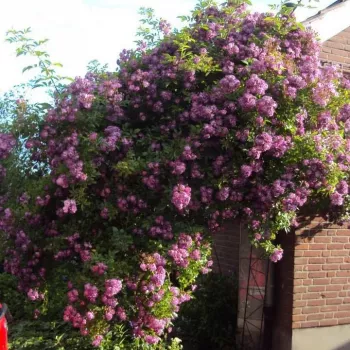
Growth and structural characteristics Strong climbing growth reaching about 4–6 m high with 2–4 m spread; slightly prickly canes; dense, mid-green, glossy foliage; medium self-cleaning, with clusters often remaining after petals fall.
Flower morphology Semi-double, flat, small flowers of 1–4 cm carried in large, clustered trusses; non-remontant, blooming once per season in a dramatic flush that can almost cover the supporting structure.
Colour data and phenology Buds deep crimson-purple, opening lighter purple-lilac with pinkish tips and paler centres; colour ARS code M, RHS 79A outer and 75B inner, fading in sun to bluish-grey and pastel lilac-blue tones.
Fragrance and aroma Sweetly spicy fragrance of mild strength, noticeable close-up without overpowering nearby seating; best appreciated in sheltered spots where air movement is gentle and blooms can be enjoyed at head height.
Hip characteristics Occasional small, spherical rose hips form after flowering, brownish-red in colour, about 5–9 mm across; hips are decorative when present but not typically the main ornamental feature of this rambler.
Resistance and winter hardiness Hardy to approximately −32 to −29 °C (USDA zone 4b, RHS H7); disease resistance medium to black spot, powdery mildew and rust; tolerates heat but needs extra watering in prolonged dry spells.
Horticultural recommendations Suitable for walls, arches, arbours and fences; prefers well-drained soil and a ventilated position; spacing 1,8–3,3 m depending on use; medium maintenance with routine tying-in and post-flowering pruning.

Choose VEILCHENBLAU for a long-lived, own-root historic rambler that smothers walls in pastel purple blossom, attracts pollinators and needs only modest yearly care, a thoughtful option for relaxed family gardens.
Detailed product attributes

Product Identification Data

Product Name: VEILCHENBLAU – purple historic rambler, running-climbing rose - Kiese
Product Type: antoniaROSE® ORIGINAL - rós i bpota 2 lítear ar a fhréamhacha féin
Cultivar Authenticity: Cigireáilte:01.06.2025
Item Number: [40] 52-533 (14.02.2026) antoniarose.ie

Name and Registration

Cultivar Name Meaning: The name means 'violet-blue' in German.
Synonym Name: Bleu-Violet; Blue Rambler; Blue Rosalie; Violet Blue
Trade Name: Veilchenblau Historic rose Kiese
Rose Group: Rambler, Historical roses, Climber, Hybrid Multiflora, Polyantha
Commercial Type: historic - rambler, climbing - trailing rose
Commercial Group: Rós stairiúil
Exhibition Category: exhibition rambler; large-area surface-covering climbing rose
Collection: Historic rose

Origin and Breeding

Initial Distributor: Johann Christoph Schmidt (Germany)
Registration Year: unregistered variety
Breeder: Hermann Kiese
Breeding Company / Institution: unknown / no data
Breeding Year: Germany, 1909
Parentage: ‘Turner’s Crimson Rambler’ × ‘Souvenir de Brod’

Awards and Honours

Horticultural Ratings and Recommendations: RHS Award of Garden Merit (1993)
Competition and Show Awards: Royal Horticultural Society – Award of Garden Merit (1993)

Growth and Structural Characteristics

Height: 400-600 cm
Spread: 200-400 cm
Growth Habit: climbing
Foliage: The variety has dense foliage. Its leaves have a glossy surface and a mid‑green colour.
Prickliness: slightly prickly
Self-Cleaning Description: The petals of spent flowers mostly fall off, while the remnants of the clusters often remain on the plant.
Self-Cleaning Intensity: self-cleaning: medium

Flower Morphology

Petal Count: 13-20
Flower Fullness: semi-double-flowered
Flower Form: flat
Flower Size: S (1 - 4 cm)
Inflorescence Type: clustered
Colour Code: ARS code: M RHS code: 79A (outer), 75B (inner)
Repeat Flowering: Non-remontant; blooms once.

Colour Data and Phenology

Colour: purple
Flower Colour: Bright crimson purple shade, paler in the centre.
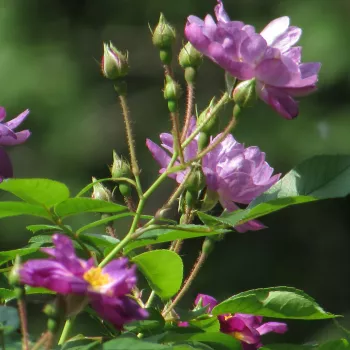
Closed Bud: Deep crimson‑purple surface with a subtle dark purple hue.
Freshly Opened Flower: Lighter purple-lilac petals with delicate pink-lilac tips.
Full Bloom: Pastel lilac–blue-lilac surface with a whitish centre.
Pre-Fading Flower: Pale lilac tone with a greyish-blue tinge.
Colour Fading Description: In heat and strong sunlight it lightens rapidly, fading from purplish to bluish-grey.

Fragrance and Aroma

Fragrance Strength: mild, subtle-scented rose
Fragrance Character: sweetly spicy
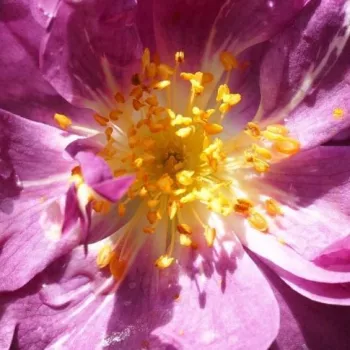
Pollinator Attraction: Semi-double flowers open flat and the exposed stamens make the pollen readily accessible, attracting pollinators.
Pollinator-Friendly Rating: Its semi-double, open-centred flowers with easily accessible stamens attract bees, so it is pollinator-friendly.

Rose Hip Characteristics

Rose Hip Shape: spherical
Rose Hip Colour: brownish-red
Rose Hip Notes: Occasionally occurring, 5–9 mm in diameter, spherical, brownish-red rose hip.

Resistance and Hardiness

Hardiness (°C): -32–-29 °C
Heat and Drought Tolerance Description: Tolerates heat well; requires watering during prolonged drought.
Disease Resistance: medium
  • powdery mildew – medium
  • black spot – medium
  • rust – medium

Horticultural Recommendations

Recommended Spacing: for mass planting 210 cm, for hedging 180 cm, as a solitary specimen 330 cm
Planting Density: in square planting 0,23 plants/m², in hexagonal arrangement 0,26 plants/m²
Partial Shade Tolerance: suitable for partial shade
Maintenance Requirements: Maintenance requirement medium; easily kept in a well‑ventilated position, but in enclosed, humid urban courtyards expect a need for plant protection.
Key Uses: arbour, pergola, wall, fence

Notes

Strengths: Soil-friendly approach – Streamlined forms
Companion Plants: Salvia nemorosa - meadow sage Cornus sericea 'White Gold' - silky dogwood Caryopteris x clandonensis - bluebeard shrub
Note: Tolerates poorer soil well.
VEILCHENBLAU – purple historic rambler, running-climbing rose - Kiese
Bright crimson purple shade, paler in the centre. - historic - rambler, climbing - trailing rose - mild, subtle-scented rose - sweetly spicy
Siopa gréasáin rósanna. - historic - rambler, climbing - trailing rose - Veilchenblau - purple - (400-600 cm)
Bláthaireacht: clustered airde: 400-600 cm Cruth na bláthanna: flat Friotaíocht gheimhridh: 6b purple - Johann Christoph Schmidt (Germany) historic - rambler, climbing - trailing rose - Méid an bhlátha: S (1 - 4 cm) Méid an bhlátha: S (1 - 4 cm) - airde: 400-600 cm airde: 400-600 cm - Líon bláthanna: semi-double-flowered Veilchenblau - Rósanna sa ghairdín | antoniaROSE® Original - standard Hermann Kiese

Léirímid cuma sheachtrach ár rósanna atá le ceannach ar líne ónár siopa gréasáin.


Which product type is right for you?


Information

In what condition do we send the roses from our online shop?

Let us ask ourselves the question: What do I want to use the rose for?
Flower? – Location? – Screening? – Fragrance? – Height? – Breeder? – Rose hips?

Rose purchase information
Payment methods – Delivery costs – Delivery – Complaints handling

Care guide

Our product is a rose grown with unique pharmaROSA® cultivation technology!

2 litre, own-root, potted rose.
With shoots appropriate to the season.
With roots thoroughly interwoven through the growing medium.
Quality in line with the requirements of the E.N.A. (European Nurserystock Association).
In unique packaging that prevents damage.
Can be planted during frost-free periods.
True-to-type rose plant with an individual identifier.

The pharmaROSA® own-root potted rose is a well-rooted plant that supports reliable establishment when planted and cared for properly, so it can be planted whenever the soil is not frozen.


Stock: several varieties and several stages of development in a short stock section.
Shoot system: intensive growth of fresh basal shoots on a young plant.
Root system: presentation of the strong root system interwoven through the growing medium with the pot removed.
Balance: mature plant where the development of the root system and the shoots is in harmony.

Information about the videos
The video series is not a “seasonal showcase”, but makes the essence of pharmaROSA® own-root production tangible: how the plant is built, what the root system is like and how the shoots renew themselves. The footage was therefore taken at different times, showing plants at different stages of development, so mixed leaf coverage or differing growth stages may appear in the videos. This is not a “sample” of the batch delivered, but an illustration of how the technology works. The current condition of the rose available to order — typical of the given period and similar to what you can expect to receive in the parcel — is shown at the top of the product page.

pharmarosa.compharmarosa.skpharmarosa.ropharmarosa.depharmarosa.co.ukpharmarosa.sipharmarosa.czpharmarosa.atpharmarosa.plpharmarosa.frpharmarosa.hrpharmarosa.espharmarosa.bepharmarosa.nlpharmarosa.iepharmarosa.grpharmarosa.bgpharmarosa.lvpharmarosa.ltpharmarosa.lupharmarosa.rufrancescarose.itpharmarosa.dkpharmarosa.ptpharmarosa.sepharmarosa.eepharmarosa.fi

Cineálacha táirgí

Pages for private customers
Garden roses for the family garden, with minimal care  → ORIGINAL®
Premium garden roses – instant impact, a truly showpiece garden  → EXTRA®
Pages for professionals and private customers
Roses for public spaces – large areas, sustainable maintenance  → NATURAL®
Roses for projects – hedge and row planting, fast implementation  → RAPID®
For professional partners only
Production – propagation material for garden roses, wholesale  → NEONATAL®

Sonraí cuideachta

PharmaRosa Ltd.
Company registration number: 01-09-717479
VAT number: 13075314-2-43
Plant health registration no.: HU130721
Bank account (IBAN):
HU85117631891388688400000000
BIC (SWIFT): OTPVHUHB
Bank name: OTP Bank Nyrt.