PERENNIAL BLUE™ – purple climbing rambler rose – Mehring
Step out to your front gate and let Perennial Blue greet you with clouds of soft purple, a cottage feeling and an easy-going climber that brings colour even where summers feel short and wet, shrugging off rainfall and coastal breezes with impressive reliability. This own-root rambler is bred for longevity: once planted and mulched, it settles in with little fuss and then repays you for years with vigorous, arching growth and repeat-flowering clusters that refresh fences, pergolas and Dublin terrace fronts alike. Think of its progress as roots in the first year, strong new shoots in the second, and full show-stopping coverage by the third, giving you a quietly spectacular rose without demanding specialist care.
Usage options
| Target area |
Reasoning |
| Family pergola over a seating area |
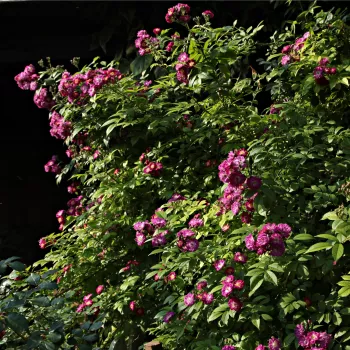
Its vigorous climbing habit and 2,4–3,8 m height quickly cover a pergola, creating a deep mauve-purple canopy with pastel lilac highlights. Once tied in during the first couple of seasons it forms a long-lived woody framework, ideal for beginners who want impact with light yearly pruning – perfect for the time-poor homeowner. |
| Dublin terraced-house front railings |
Slender, flexible canes and clusters of small, semi-double blooms make it easy to train along railings and porch uprights without blocking the path. Medium maintenance needs suit city gardeners who can give an occasional tidy and feed; colour holds best in typical Irish light, even with cool summers and frequent showers – ideal for the busy urban gardener. |
| Cottage-style boundary fence |
Repeat-flowering waves of lavender-purple clusters bring that “old-fashioned rambler” look, but on a modern, ADR-awarded plant with reliable health. Spaced at around 2 m, plants knit together into a romantic, semi-transparent screen that keeps flowering from early summer to autumn, delighting any nature-loving beginner. |
| Arched entrance or garden tunnel |
It is purpose-made for arches and tunnels, with long, trainable stems and abundant flowering on side shoots. Once established on its own roots, it builds a durable framework that regenerates well if canes are ever damaged, extending the arch’s life for many seasons – reassuring for the long-term focused buyer. |
| Partially shaded side passage |
This rose tolerates partial shade, so it copes well in side passages or north-east aspects where sun is limited. Colours often show richer bluish-purple tones in cooler, shadier spots, giving you good ornamental value where many climbers sulk, especially in small Irish gardens – a smart option for the practical gardener. |
| Wildlife-friendly family corner |
Semi-double flowers offer moderate access for bees and hoverflies, then set small red hips in autumn that lend extra seasonal interest. While not the top pollinator magnet, it contributes usefully to a mixed, wildlife-friendly scheme when paired with herbs and perennials, suiting any gently eco-minded family. |
| Low-maintenance long-term feature on a wall |
Clothed in mid-green, slightly glossy foliage and with medium disease resistance, it copes steadily with Irish humidity when given decent air movement and a mulch to improve drainage in heavier clay. Once anchored, it needs just moderate feeding and annual pruning to stay showy, suiting the maintenance-averse owner. |
| Large container by front door (over 50 litres) |
In a 50–60 litre container with good drainage, it becomes a dramatic focal point, its clusters tumbling over an obelisk or trellis. Own-root growth means that, with occasional repotting and refreshment of compost, the same plant can give many years of colour and structure in a confined space – ideal for the pot-loving gardener. |
Styling ideas
- Cottage-arch – Train over a rustic wooden arch, underplant with chives and dwarf French marigolds for a soft, “girly” cottage look – for romantic front-garden creators.
- Lavender-rill – Let canes spill along a fence, weaving between clumps of Nepeta and hardy geraniums to echo the mauve-purple flowers – for relaxed, naturalistic planters.
- Cherry-sorbet – Combine with pale pink shrub roses and white foxgloves on a boundary, allowing repeat flushing to keep the backdrop colourful – for those who like gentle, layered colour.
- Urban-screen – Use a slim trellis against a terrace façade, with grasses like Stipa tenuissima at the base to soften the line while keeping care simple – for style-conscious city dwellers.
- Berry-glow – Highlight its red hips in autumn by pairing with purple heucheras and evergreen euphorbias, extending interest well beyond peak flowering – for four-season focal-point seekers.
Technical cultivar profile
| Parameter |
Data |
| Name and registration |
Rambler and large-flowered climber, registered as Mehv9601, marketed as PERENNIAL BLUE™ and Perennial in the Perennial collection; exhibition name Perennial Blue, exhibition rambler and climbing rose category. |
| Origin and breeding |
Bred by Bernard F. Mehring in the United Kingdom from Super Excelsa × Veilchenblau, introduced by Eurosa in Germany in 2003 as a modern, continuously flowering purple rambler-climber selection. |
| Awards and recognition |
Holds ADR status in Germany since 2013, indicating tested garden performance, plus Baden-Baden Silver Medal 2006 and first prize at Baden bei Wien 2014 for ornamental and horticultural quality. |
| Growth and structural characteristics |
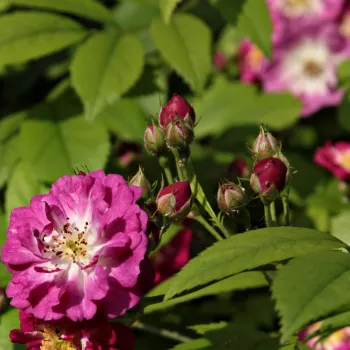
Strong climbing habit reaching around 240–380 cm high and 150–260 cm spread, with moderately dense, mid-green, slightly glossy foliage and moderately thorny shoots suitable for training on supports. |
| Flower morphology |
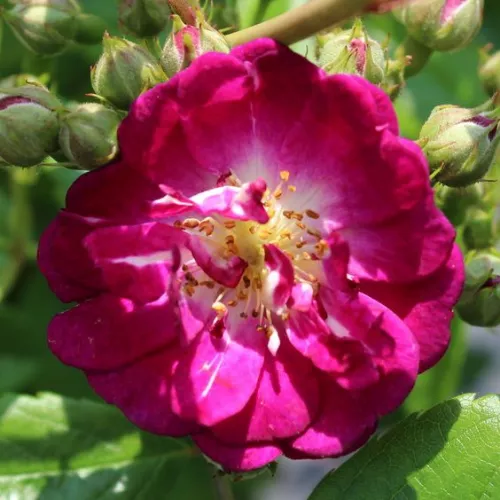
Semi-double cup-shaped blooms, 1–4 cm wide, carry 13–25 petals in large, cluster-flowered sprays; remontant habit ensures a generous second flush and further flowers into late season under good care. |
| Colour data and phenology |
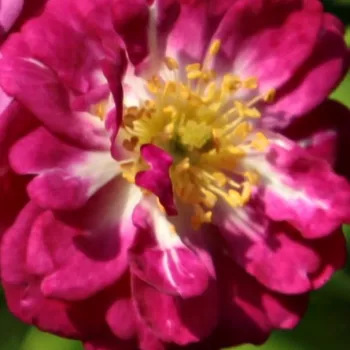
Mid-saturated crimson-purple base with silvery bloom, RHS 77A outer and 77B inner, opening vivid mauve-purple then fading to greyish lilac; colour deeper in cool weather, softer and paler in strong sun. |
| Fragrance and aroma |
Fragrance is very faint, with a light, fresh, fruity character only noticeable at close range, so it is chosen more for its distinctive colour effects and flower masses than for strong scent impact. |
| Hip characteristics |
Develops spherical red hips about 6–10 mm across in moderate quantities after flowering, adding autumn and early winter interest, particularly visible where pruning is light and spent clusters are retained. |
| Resistance and winter hardiness |
Rated to around −21 to −18 °C, USDA zone 6b and RHS H7; disease resistance is medium for black spot, powdery mildew and rust, responding well to good air circulation and occasional preventive care. |
| Horticultural recommendations |
Best on well-drained but moisture-retentive soil, spaced 190–300 cm depending on use; tolerates partial shade, benefits from mulching on heavier clay and moderate watering during establishment and dry spells. |
PERENNIAL BLUE™ offers richly coloured repeat flowering, durable climbing structure and long-lived own-root reliability; a thoughtful choice if you would like a graceful, low-fuss rambler for your Irish garden.