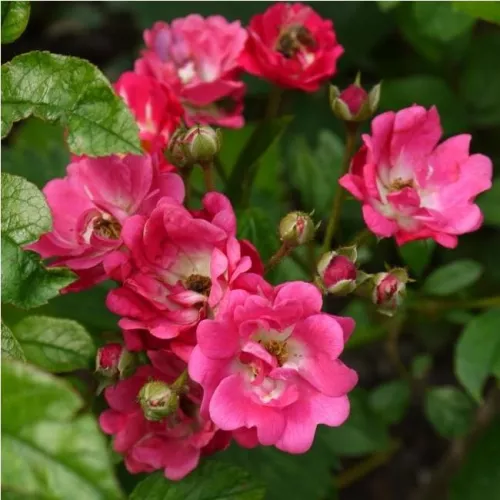
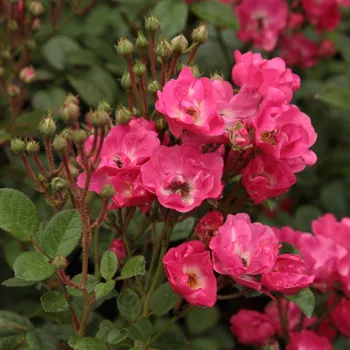
ORLÉANS ROSE – pink polyantha bedding rose – Levavasseur
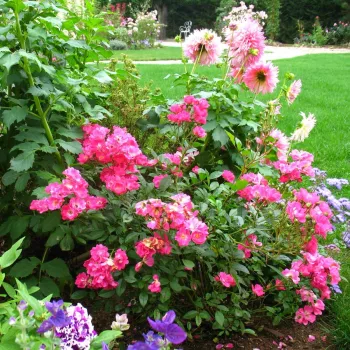
ORLÉANS ROSE brings a feeling of cheerful charm to small Irish gardens, covering its compact frame with clusters of pink blooms that refresh themselves thanks to good self-cleaning. Ideal for relaxed front gardens, it suits the “girly” cottage look yet stays neat and easy to manage, even when life is busy. Planted in a sunny spot with decent drainage, it copes well with our breezy, damp climate and frequent showers, quietly repeating its display through the short summer season. As an own-root shrub it builds strength year by year, from roots in year one to fuller shoots in year two and a settled, harmonious garden presence by year three, rewarding you with long-term reliability, gentle maintenance, and a soft, light cottage atmosphere.
Usage options
| Target area |
Reasoning |
| Low cottage-style front border |
The compact 60–85 cm habit and dense, glossy foliage make it ideal for a low border along a path or railings, giving a traditional cottage feel without becoming leggy or overpowering a small space – perfect for the beginner. |
| Repeat-flowering bedding in a family garden |
Clustered, semi-double blooms appear in generous flushes, with a notably abundant second wave, keeping beds colourful through our relatively short summer and reducing the need to replant seasonal bedding – ideal for the time-poor. |
| Easy-care flowering hedge along a drive |
At 40 cm spacing, plants knit into a tidy, low hedge, and their good self-cleaning means fewer deadheading sessions to keep the line presentable on busy weeks – a practical choice for the commuter. |
| Small urban front garden or terrace plot |
The moderate overall size, light green foliage and continuous pink clusters give strong impact in tight spaces, while own-root resilience offers a long-lived framework that copes well with everyday urban routines – reassuring for the newcomer. |
| Clay soil border with improved drainage |
Once planted into clay that has been loosened and enriched with grit and compost, the own-root system settles in steadily and shrugs off blustery, rain-laden weather typical of exposed Irish sites – especially helpful for the coastal. |
| Mixed perennial bed with late-summer partners |
The soft pink clusters blend beautifully with dwarf asters and coneflowers, while the shrub’s long flowering season provides a stable backbone around which perennials can rise and fall – appealing to the planner. |
| Long-term mass planting in public or shared spaces |
Medium maintenance needs and own-root longevity make it well suited to mass planting where replanting budgets are limited; plants recover better from accidental damage and keep beds looking established for many years – useful for the caretaker. |
| Large patio container or doorstep feature |
In a 40–50 litre or larger container with good drainage, its compact frame and repeat pink clusters provide an inviting welcome by the front door, with only occasional feeding and pruning required – attractive for the busy-owner. |
Styling ideas
- Cottage-Ribbon – Plant a drift along a path with soft pink clusters edging gravel, weaving in dwarf asters for late-season sparkle – suited to romantically minded homeowners.
- Terrace-Trim – Use as a neat low hedge in Dublin terraced fronts, underplanted with spring bulbs for early colour – ideal for city dwellers wanting order and charm.
- Pink-Canvas – Mass-plant in threes or fives in a small lawn island, adding coneflowers behind for height and contrast – good for families seeking simple structure.
- Doorstep-Jewel – Grow one plant in a generous 50 litre pot near the front door, with trailing thyme around the rim – perfect for those with only a tiny hardstand.
- Park-Edge – Line the edge of a shared green or parking bay with evenly spaced shrubs, keeping a consistent, low-maintenance pink border – fitting for residents’ committees and tidy-town groups.
Technical cultivar profile
| Parameter |
Data |
| Name and registration |
Polyantha shrub rose, trade name ORLÉANS ROSE, collection garden rose, exhibition category shrub and cluster-flowering rose, named for the French city of Orléans where breeder Levavasseur lived. |
| Origin and breeding |
Raised by Ernest Levavasseur in Orléans, France, as an open-pollinated seedling of ‘Madame Norbert Levavasseur’; introduced in France in 1909 and in Australia in 1911 via Hazlewood Bros. |
| Growth and structural characteristics |
Compact, bushy polyantha with dense, light green glossy foliage; height and spread typically 60–85 cm, moderately thorny stems, forming a rounded, tidy shrub suited to edging or bedding. |
| Flower morphology |
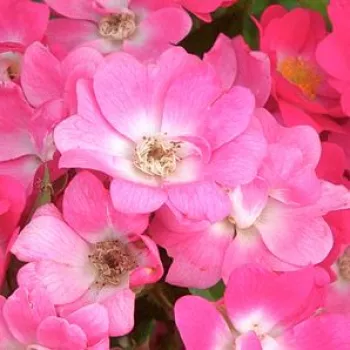
Semi-double, cup-shaped clusters of small blooms, 1–4 cm in diameter, borne freely in trusses; around 13–25 petals per flower, with strong repeat-flowering and particularly abundant second flushes. |
| Colour data and phenology |
Vibrant deep pink buds opening to rich pink flowers, ARS dp, RHS 55C–55B; upper surface deep pink, paler pink-white beneath, fading gradually to powder pink-white, slower to fade in cool conditions. |
| Fragrance and aroma |
Fragrance is very weak and generally barely noticeable, with no defined character recorded; ornamental effect relies primarily on colour, clustering habit and repeat flowering rather than scent. |
| Hip characteristics |
Occasional small hips form after flowering; roughly spherical, 7–10 mm diameter, colouring orange-red and adding a modest seasonal accent if deadheading is not carried out too thoroughly in late season. |
| Resistance and winter hardiness |
Hardy to about −21 to −18 °C (RHS H7, USDA 6b, Swedish zone 3); moderate tolerance to heat and drought with watering in dry spells; disease resistance moderate to black spot, mildew and rust. |
| Horticultural recommendations |
Best in full sun with fertile, well-drained soil; spacing 50 cm for bedding, 40 cm for hedges, 75 cm as specimen; planting densities around 4.2–4.8 plants/m² depending on layout and design intent. |
ORLÉANS ROSE offers compact growth, abundant repeat pink flowering and dependable self-cleaning on a durable own-root framework, making it a thoughtful choice for long-lived, low-fuss planting.