MORSDAG® – red bedding polyantha rose – Grootendorst & Goey
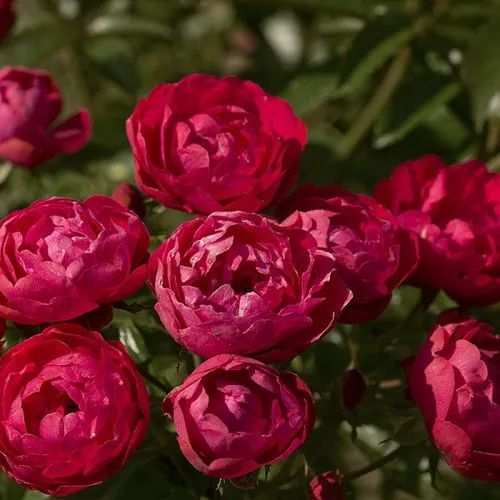
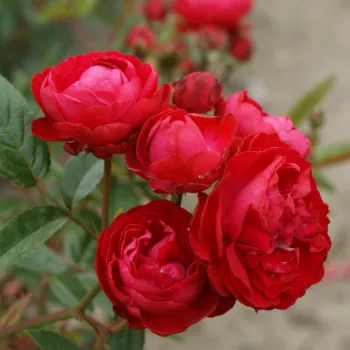
Step outside after the rain and let the neat, low mounds of MORSDAG® set a tone of quiet contentment in your front garden or cottage border, its small crimson pompons glowing in the soft Irish light even when the sky is grey and showers keep the soil moist despite heavy clay and changeable weather. This compact polyantha forms a dense, dark green hedge of foliage, dotted all summer with clusters of red blooms that open and reopen in generous waves, keeping colour going long after many plants have finished. Easy to tuck into narrow beds, edging and large containers, it offers reliable structure with only occasional light pruning and deadheading, while its own-root nature means it can quietly regenerate from the base, building up a stronger, broader shrub over the seasons. Ideal for busy households who want long-lasting impact rather than complicated care, it will steadily increase in presence as roots establish, top growth fills out and, by its third year, the plant settles into a full, long-lived garden feature.
Usage options
| Target area | Reasoning |
|---|
| Front-of-border edging in small family gardens |
The compact 40–60 cm height and 60–90 cm spread create a tidy, low edging that frames paths or lawns without overwhelming a modest Irish garden. Repeating clusters of small, double red flowers give continuous structure and colour along the border edge with minimal shaping, suiting beginners. |
| Bedding and mass planting in cottage-style schemes |
Planted at 55 cm spacing, this polyantha forms a dense, flowering carpet, ideal for old-fashioned cottage beds that need reliable structure. Its remontant habit delivers an abundant second flush, so beds in short Irish summers remain cheerful and full, rewarding busy-urban-owners. |
| Low informal hedge along drives and front boundaries |
At around 45 cm spacing, MORSDAG® knits into a low, glossy green hedge, studded with crimson pompons. Light prickliness and moderate self-cleaning make it family-friendly near paths, with just occasional deadheading to keep it neat, well suited to time-poor-gardeners. |
| Containers and large pots on patios and terraces |
This compact, dense plant thrives in a 40–50 litre container, where its dark foliage and rich red flowers bring long-season colour to paved spaces. Own-root growth ensures resilience if top shoots suffer, so the plant can regrow strongly, reassuring cautious first-time-buyers. |
| Low-maintenance family gardens on heavier Irish soils |
MORSDAG® tolerates typical Irish conditions, coping well where rainfall keeps heavy soils damp as long as you provide reasonable drainage. Moderate disease resistance and a robust root system help it settle into slightly challenging spots, encouraging relaxed-homeowners. |
| Urban front gardens and small Dublin terraces |
The neat growth habit suits narrow beds under windows or beside steps, giving a formal yet friendly welcome without demanding constant pruning. Year by year roots strengthen, then top growth fills out, until by the third season it offers full ornamental value for city-dwellers. |
| Mixed shrub plantings in parks and shared green spaces |
Its durable, own-root habit and H7 hardiness make it a sound long-term choice where plants must cope with variable care. Massed planting provides clear seasonal colour and a tidy look, with only periodic maintenance visits, meeting the needs of community-managers. |
| Family play gardens needing safe, low, lightly thorned roses |
MORSDAG® has only light prickles and stays low, so it fits well near play areas where a full-sized rose might be intrusive. The rounded form and steady flowering offer interest for children and adults alike, without dominating precious space, ideal for young-families. |
Styling ideas
- Cottage-Ribbon – Run a sinuous line of MORSDAG® along a path, interplanted with soft pink geraniums to contrast with its deep red pompons – perfect for romantic cottage-garden enthusiasts.
- Crimson-Courtyard – Use three plants in a 50 litre terracotta pot, underplanted with white alyssum, to create a compact, fragrant accent beside a townhouse door – ideal for city terrace owners.
- Heritage-Hedge – Form a low hedge backed by lavender and catmint so the dark red flowers pop against cool blues and silvers – great for those restoring period-style front gardens.
- Playful-Edging – Edge a family lawn with MORSDAG® and low ornamental grasses, giving soft movement behind the neat red blooms – suited to families wanting colour without tall, spiky plants.
- Parklet-Patchwork – Combine blocks of MORSDAG® with groundcover roses in softer tones to create a durable colour mosaic in shared green spaces – useful for residents’ groups planning communal beds.
Technical cultivar profile
| Parameter | Data |
|---|
| Name and registration |
MORSDAG® bedding rose, polyantha group, trade name used for compact red bedding rose; ARS exhibition name ‘Mothersday’, unregistered cultivar commonly listed in garden and show catalogues. |
| Origin and breeding |
Historic polyantha derived from a spontaneous red sport linked to ‘Dick Koster’ and older rugosa lineage; bred in the Netherlands by F. J. Grootendorst and J. de Goey, introduced mid‑twentieth century. |
| Awards and recognition |
Recognised in American Rose Society local exhibitions, securing repeated first places in the ‘Polyantha spray’ class during the late 1990s and early 2000s, reflecting enduring show and garden appeal. |
| Growth and structural characteristics |
Compact, bushy shrub reaching about 40–60 cm in height and 60–90 cm wide, with dense, dark green, glossy foliage and only light prickliness, forming rounded mounds suitable for edging and low hedging. |
| Flower morphology |
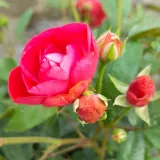
Produces small, double pompon to ball-shaped blooms, typically 1–4 cm across with 26–39 petals, carried in generous clusters; remontant habit gives strong initial flush followed by abundant repeat flowering. |
| Colour data and phenology |
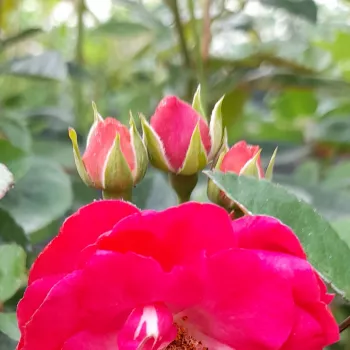
Velvety crimson red buds open to rich, uniform deep red blooms, subtly lightening to a clear mid red without muddiness; colour holds well in sun and rain, providing stable bedding impact through the season. |
| Fragrance and aroma |
Fragrance is very weak, with only a faint rose-like note discernible at close range; mainly selected for colour and garden effect rather than perfume, suiting sites where strong scent is not required. |
| Hip characteristics |
Rose-hip set is generally sparse because of the double blooms; when present, hips are small, spherical, bright red structures around 5–7 mm across, adding only occasional decorative interest late season. |
| Resistance and winter hardiness |
Hardy to approximately −26 to −23 °C (H7, USDA 5b), with good resistance to powdery mildew and black spot, moderate rust susceptibility, and adequate heat tolerance given regular watering in dry spells. |
| Horticultural recommendations |
Best in well-drained but moisture-retentive soil; space 45–85 cm depending on use, water reliably in dry periods, and deadhead to maximise repeat bloom; suitable for beds, edging, groundcover and larger containers. |
MORSDAG® offers compact crimson bedding colour, dependable repeat flowering and long-lived own-root resilience, making it a thoughtful, low-fuss addition to brighten everyday family garden spaces.