MOONSPRITE – cream-yellow bedding floribunda rose - Swim
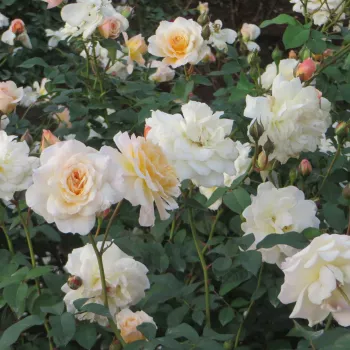
If You like a gentle, romantic cottage-garden feel without complicated care, Moonsprite settles beautifully into small Irish gardens, bringing softly glowing clusters of creamy, buttery blooms and a strong, fresh citrusy fragrance. Its bushy habit stays compact enough for front beds and terraced-house fronts, while repeat flushes keep colour going even through a cool, short summer with showery spells and mild Atlantic winds. Once planted with decent drainage and a light mulch, this own-root rose is bred for a long, reliable garden life, steadily building roots, then shoots, then full ornamental presence over its first three years. With only medium maintenance, occasional dead-heading and simple seasonal care, You gain a long-lived, cheerfully glowing focal point that fits perfectly into a softly textured, “girly” Irish border.
Usage options
| Target area |
Reasoning |
| Cottage-style front garden border |
The compact, bushy growth and 80–105 cm height make Moonsprite ideal for edging a low boundary or path where its creamy-yellow clusters sit at eye and nose level. Remontant flowering keeps it interesting across a short Irish summer, giving a constant, gentle welcome for beginners. |
| Small family flower bed near seating |
The strong, fresh citrus perfume carries well around a patio or seating nook, and moderately dense, dark foliage frames the pastel blooms for evening relaxation. Plant 75 cm apart as specimens so air can move between bushes and reduce humidity‑related problems for urban-owners. |
| Mass planting in front garden |
At 4.2–4.8 plants per square metre, a group of Moonsprite forms an even, colour-coordinated carpet of creamy-yellow cups that read as one soft block from the street. This simple, repeated scheme offers high visual impact without complex design work for time-poor. |
| Low hedge along path or driveway |
Spacing at about 40 cm creates a low, airy hedge that defines paths without feeling formal or heavy. Moderate self-cleaning means fewer dead blooms to pick up, keeping front approaches neat with only occasional quick tidying for busy-families. |
| Mixed “girly” border with grasses and perennials |
The cream-yellow flowers blend beautifully with soft grasses and pink or blue cottage plants such as Stipa tenuissima or Lychnis, offering a breathable, low-chemical garden concept. Grouped at 50 cm, they weave through companions like a luminous thread for romantics. |
| Urban clay-soil garden with rainfall |
Moonsprite copes well in typical Irish clay if You improve drainage with grit and keep a light organic mulch; once established, its own-root system supports long lifespan and stable flowering, even in breezy, rain-prone Atlantic conditions for practical-gardeners. |
| Family garden feature bed |
With its cluster-flowering habit and plentiful second flush, Moonsprite provides months of blossoms children notice and adults enjoy, without constant fussing. Allow space around each bush so as it matures the rounded shape becomes a reliable, long-term feature for homeowners. |
| Own-root replacement for older grafted roses |
As an own-root plant, Moonsprite regenerates well from the base, avoiding suckering issues of grafted roses and maintaining true-to-type flowering over many seasons; after the first year’s root focus, it builds shoots in year two and full ornamental effect in year three for long-term-planners. |
Styling ideas
- Lemon-cream pathway – Line a narrow front path with Moonsprite at 50 cm intervals and underplant with low lavender for contrast – ideal for fragrance-lovers seeking a soft daily welcome.
- Moonlit cottage patch – Combine Moonsprite with Stipa tenuissima and pale pink perennials for a breezy, romantic bed that moves gently in the wind – perfect for fans of informal Irish cottage gardens.
- Terraced-front accent – Place a small group near the doorstep so clusters of creamy blooms and citrus scent greet visitors – suited to city dwellers wanting charm in limited space.
- Soft family seating corner – Plant Moonsprite behind a low bench, mixing with blue Caryopteris for colour contrast and relaxed structure – great for families who unwind outdoors after work and school.
- All-season structure – Use repeated clumps of Moonsprite to knit together shrubs and perennials, its bushy habit giving year-round structure even when not in flower – for gardeners favouring low-effort, cohesive planting.
Technical cultivar profile
| Parameter |
Data |
| Name and registration |
Floribunda bedding rose Moonsprite, registered cultivar name Moonsprite, trade name Moonsprite Bedding rose Moonsprite, ARS exhibition name Moonsprite, unregistered in formal registration lists. |
| Origin and breeding |
Bred by Herbert C. Swim at Armstrong Nurseries, Ontario, California, USA. Introduced 1956. Parentage: ‘Sutter’s Gold’ × ‘Ondine’, representing classic mid‑century floribunda breeding lines. |
| Awards and recognition |
Gold medal winner at Baden-Baden rose trials in 1955 and at Rome in 1956, reflecting strong historical garden performance and ornamental value acknowledged by expert juries. |
| Growth and structural characteristics |
Bushy shrub rose, 80–105 cm high and 60–85 cm spread, moderately thorny, with moderately dense, slightly glossy dark green foliage, forming a rounded, compact outline suitable for bedding and edging. |
| Flower morphology |
Very double, cup-shaped flowers with 40+ petals, medium-sized at 4–7 cm, borne in clusters. Remontant habit with generous second flush, providing repeated floral displays throughout the growing season. |
| Colour data and phenology |
Cream-yellow blooms, ARS yb, RHS 11D outer and 12C inner. Buds pale lemon-yellow, opening buttery-yellow, then fading to creamy white with only a slight yellow sheen as flowers age on the plant. |
| Fragrance and aroma |
Strong, distinctive scent with a full, fresh citrus character; fragrance noticeable at close range and around small seating areas, making it well suited to paths, patios and intensively used garden corners. |
| Hip characteristics |
Occasional spherical orange-red hips, 8–12 mm diameter, adding discreet late-season interest but not a dominant ornamental feature; usually removed in managed bedding schemes to encourage repeat flowering. |
| Resistance and winter hardiness |
Hardy to about -21 to -18 °C, RHS H7, USDA zone 6b, Swedish zone 3. Disease resistance moderate overall: black spot resistant, powdery mildew and rust moderate, benefits from basic preventative care. |
| Horticultural recommendations |
Best in full sun with improved drainage on clay soils; medium maintenance with occasional pest and disease monitoring. Spacing 40–75 cm depending on use; suitable for beds, edging, hedging and urban green spaces. |
MOONSPRITE offers romantic creamy-yellow clusters, a strong citrus fragrance and dependable repeat flowering on a resilient own-root shrub, making it a thoughtful long-term choice for relaxed Irish gardens.