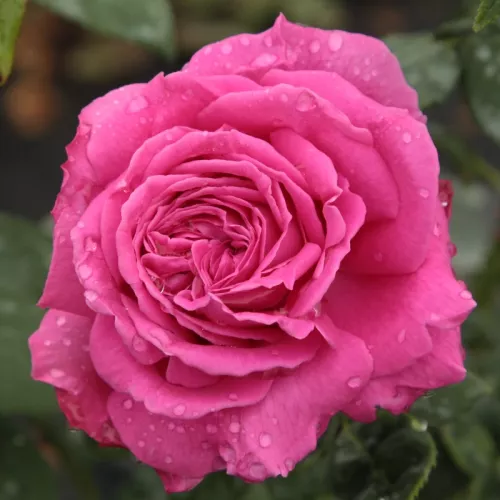
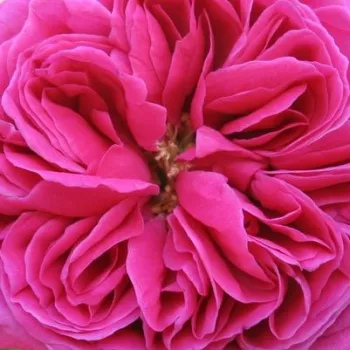
MADAME ISAAC PEREIRE – deep pink historic Bourbon rose
Step outside into a soft Irish drizzle and meet heritage romance in living form: Madame Isaac Pereire, a richly perfumed Bourbon rose that shrugs off rainfall and damp with impressive disease resistance, yet asks remarkably little of you. This own‑root shrub settles in steadily, rewarding simple, well‑drained planting with strong regrowth after pruning and a naturally arching habit that suits both cottage borders and Dublin terrace fronts. Its deeply cupped, fragrant blooms repeat through the short Irish summer, building up from a quiet first season to fuller foliage and flowering by year two, before reaching its generous, long‑lived character around year three, so you can relax into lasting, low‑effort garden pleasure and old‑rose abundance.
Usage options
| Target area |
Reasoning |
| Feature shrub in a front garden bed |
Its naturally upright, arching shrub habit makes an immediate focal point, giving height and structure without complicated training; own‑root growth keeps that shape reliable for years, ideal for a low‑effort welcome for busy homeowners. |
| Romantic cottage‑garden border |
Continuous, remontant flowering in deep pink tones brings classic cottage charm even in a short Irish summer with frequent rain and soft light, maintaining ornamental value over many seasons for nature‑loving gardeners. |
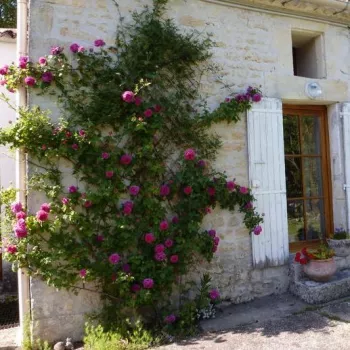
| Low pergola or arch support |
Strong, arching canes can be tied onto a low support or arch, creating hanging curtains of bloom with minimal pruning, while the own‑root base quietly renews older canes for casual garden stylists. |
| Warm, fragrant seating corner |
The extremely strong, room‑filling perfume turns a small patio or bench area into an evening retreat; one shrub near a path or seat can provide all the scent you need for fragrance enthusiasts. |
| Specimen rose in a lawn or gravel area |
Planted alone with generous space, its XL rosette blooms and dark foliage stand out from a distance; long‑term stability on its own roots means a dependable centrepiece for long‑range planners. |
| Large container by a front door |
In a 40–50 litre pot with good drainage, its steady, upright growth and repeat flowering dress entrances without complex care routines, suiting paved or compact spaces for urban dwellers. |
| Low‑maintenance traditional rose bed |
Strong resistance to black spot, mildew and rust in our humid climate keeps foliage clean with minimal spraying, so a classic rose display remains attractive with simple deadheading for time‑pressed beginners. |
| Historic rose collection corner |
An 1880 Bourbon with documented show history, it adds genuine period character and storytelling interest, while its own‑root longevity protects your planting investment for heritage collectors. |
Styling ideas
- Cottage Romance – Underplant with catmint and airy grasses to soften the arching shrub and echo its raspberry‑pink tones – for lovers of relaxed, storybook borders.
- Front‑Step Welcome – Grow it in a large terracotta pot with white lobelia at the base, letting the rich blooms frame your doorway – for city terrace and townhouse entrances.
- Heritage Backdrop – Combine with foxgloves and old‑fashioned phlox along a fence, using its height and classic blooms as a scented screen – for fans of traditional Irish gardens.
- Evening Perfume – Place near a favourite bench with lavender and hardy geraniums, so repeat flowers and strong scent enrich dusk sitting – for those who linger outdoors after work.
- Soft Structure – Train the arching canes on a low obelisk among clay‑tolerant perennials, turning its upright habit into a vertical accent – for gardeners seeking easy, elegant form.
Technical cultivar profile
| Trait |
Data |
| Name and registration |
Historic Bourbon shrub rose, trade name Madame Isaac Pereire; part of the Heritage rose collection, ARS exhibition name Madame Isaac Pereire; unregistered cultivar with French origins. |
| Origin and breeding |
Bourbon rose bred in France by Armand Garçon, distributed by Margottin père & fils; introduced around 1880–1881, with parentage unknown and typical of nineteenth‑century selection. |
| Awards and recognition |
Historic show success including recognition at the Société botanique d’Angleterre rose competition in London in 1882, confirming its ornamental merit among period rosarians. |
| Growth and structural characteristics |
Vigorous, upright shrub 170–230 cm high and 120–180 cm wide, with strongly arching canes, moderately dense dark green foliage and moderate prickliness; can be trained on low supports. |
| Flower morphology |
Very double rosette blooms, typically over 10 cm across, borne mostly solitary on stems; each flower packed with 40 or more petals, creating a luxuriously full, old‑rose appearance. |
| Colour data and phenology |
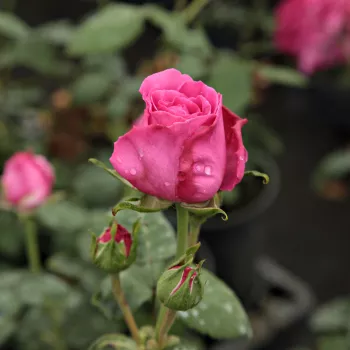
Deep crimson‑pink to fuchsia with lilac tints; buds dark carmine, opening vivid then fading to pale raspberry under strong sun; remontant with a notably abundant second flush in season. |
| Fragrance and aroma |
Extremely strong, room‑filling perfume with an elegant old‑rose character, ideal for fragrance gardens and cut stems where the scented, velvety blooms can be appreciated indoors. |
| Hip characteristics |
If spent blooms are left, forms a small number of spherical 12–18 mm hips, coloured red‑orange; ornamental interest is secondary to the heavily double, petal‑rich flowers. |
| Resistance and winter hardiness |
Robust in cold climates to about −26 to −23 °C (USDA 5b, RHS H7); good resistance to black spot, powdery mildew and rust, but needs regular watering in dry, hot conditions. |
| Horticultural recommendations |
Suited to beds, specimen use, pergolas and walls; prefers fertile, well‑drained soil, tolerates partial shade; allow 125–210 cm spacing depending on use for balanced, open growth. |
MADAME ISAAC PEREIRE offers sumptuous fragrance, repeat flowering and strong disease resistance on a long‑lived own‑root framework; a thoughtful choice if you value enduring beauty with modest effort.