LOLLIPOP™ – red dwarf-mini rose - Moore
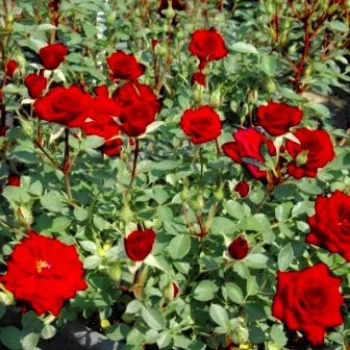
Step outside for a moment of cheerful calm with LOLLIPOP™, a dainty red miniature rose that brings cottage-garden charm to the smallest Dublin terrace or country front path. Its compact, bushy habit and glossy mid-green foliage keep borders looking neat, while clusters of pompon blooms repeat from early summer well into autumn, even when summers feel short and soft light dominates. This own-root plant settles in steadily, building strong roots, then fuller shoots, and by the third year delivers its complete impact with minimal fuss. Good natural self-cleaning keeps it looking fresh without constant deadheading, and moderate disease resistance – especially to black spot – supports easy-going maintenance in real Irish weather with regular rainfall and humidity.
Usage options
| Target area |
Reasoning |
| Edging a cottage-style path |
The compact 30–40 cm height and 25–35 cm spread form a low, colourful line along paths, steps, or narrow front-garden beds. Self-cleaning flowers keep the edge tidy without regular clipping or deadheading – perfect for the busy homeowner |
| Small front-garden feature |
Clusters of mid-red pompon blooms draw the eye without overwhelming tight spaces typical of terraced houses. Regular repeat flowering means there is nearly always some colour at the front door to welcome visitors – ideal for the urban gardener |
| Low flowering hedge |
Planted at 25 cm, LOLLIPOP™ creates a low, informal hedge that children can see over, while dense foliage gives a neat green line in winter. Own-root growth helps the hedge regenerate evenly over many years – reassuring for the long-term planner |
| Container on patio or balcony |
Its dwarf habit suits a 40–50 litre pot, where good drainage and regular watering support healthy growth. In a container it can be placed where you most enjoy its playful red blooms over a long season – convenient for the apartment dweller |
| Mixed flower bed with perennials |
Recommended spacing of 30–50 cm lets you weave it between hardy perennials like Campanula, oregano, or tufted hairgrass. This creates a soft, natural look while the rose offers structure and repeating colour – attractive to the nature lover |
| Family garden play area edge |
The sparsely thorned stems and low, compact habit make it a gentler choice near paths or lawn edges where children pass. Its modest size stays in scale with small lawns and seating spots – reassuring for the young family |
| Pollinator-friendly corner |
Although double-flowered, LOLLIPOP™ still offers some interest to insects, especially when paired with nectar-rich companions. Continuous clusters of blooms add colour and buzz to even a small wildlife corner – inspiring for the eco-conscious gardener |
| Reliably colourful Irish border |
Remontant flowering with an abundant second flush keeps the border lively through a cool, damp season, providing steady colour despite frequent showers and overcast days that shorten our sense of summer – confidence-building for the beginner |
Styling ideas
- Cottage-edge ribbon – Line both sides of a front path with LOLLIPOP™ at 25–30 cm spacing for a neat, low red ribbon that feels traditionally Irish yet easy to maintain – ideal for owners of country cottages.
- Terrace window stage – Plant three in a 40–50 litre trough below a front window, underplanting with trailing thyme for scent and softness – perfect for small-city terraces.
- Herb-and-rose mix – Combine LOLLIPOP™ with oregano and chives in a sunny bed, letting the rose give structure while herbs feed pollinators – suited to kitchen-garden enthusiasts.
- Soft grass contrast – Dot plants between clumps of Deschampsia cespitosa so red pompon blooms float above fine grasses, creating gentle movement – appealing for naturalistic-style gardeners.
- Mini hedge frame – Use closely spaced plants to frame a small lawn or children’s sandpit, providing a low, colourful boundary that stays in scale – great for family gardens.
Technical cultivar profile
| Parameter |
Data |
| Name and registration |
Miniature dwarf rose LOLLIPOP™, registered cultivar name Lollipop, trade name Lollipop™ Mini - dwarf rose Lollipop; unregistered in formal registers but recognised in miniature rose circles. |
| Origin and breeding |
Bred by Ralph S. Moore, Sequoia Nursery, United States, 1959; parentage 0-47-19 (Rosa wichurana × ‘Floradora’) × ‘Little Buckaroo’; introduced in the USA in 1959 and Australia in 1962. |
| Growth and structural characteristics |
Compact, bushy habit, about 30–40 cm high and 25–35 cm wide; dense, glossy mid-green foliage with sparse thorns. Well suited to edging, low hedges, and containers in small gardens. |
| Flower morphology |
Small 1–4 cm double spherical pompon blooms with 26–39 petals, carried in clusters; remontant with a notable second flush that keeps the plant colourful across the main growing season. |
| Colour data and phenology |
Uniform mid-red tone, ARS code MR, RHS 46A outer and 46B inner petals; deeper red buds, colour lightens in strong sun, fading slightly pinkish rather than darkening; even red at full bloom. |
| Fragrance and aroma |
Very weak fragrance with a discreet, elegant character; not chosen primarily for scent but for compact habit, repeat flowering, and its tidy clusters of bright miniature blooms. |
| Hip characteristics |
Occasional small spherical hips, 5–7 mm in diameter, orange-red RHS 41A; of mainly ornamental interest and not produced in large numbers on well-deadheaded garden plants. |
| Resistance and winter hardiness |
Hardy to about -21 to -18 °C, RHS H7, USDA zone 6b; disease resistance medium overall with good black spot resistance but moderate susceptibility to powdery mildew and rust in humid conditions. |
| Horticultural recommendations |
Prefers sunny positions with moist, well-drained soil; spacing 25–50 cm depending on use. In pots, choose at least 40 litres with drainage and mulch; monitor foliage for mildew and rust in damp summers. |
LOLLIPOP™ offers long-season red colour in a compact form, with self-cleaning blooms and a durable own-root constitution that suits relaxed Irish gardens, so you may like to consider it as a long-term feature for your space.