JOSEPH'S COAT – yellow-red climbing rose - Armstrong & Swim
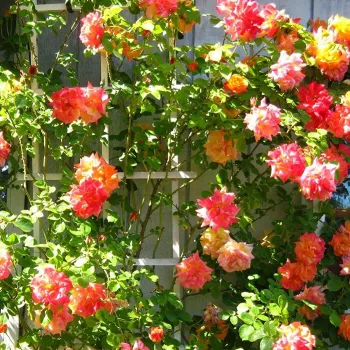
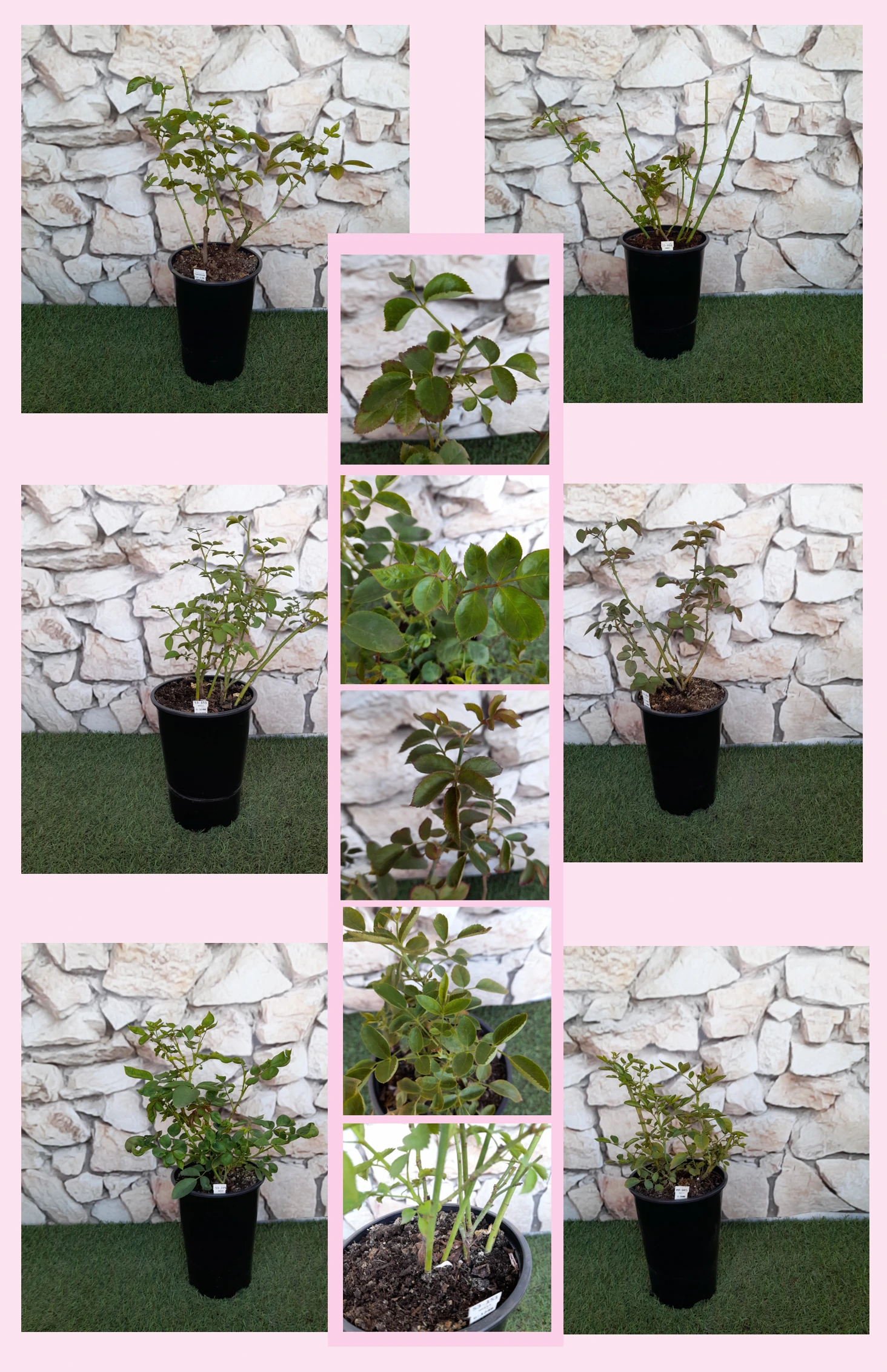
Step out to your front door and meet Joseph's Coat as it pours ribbons of colour over walls, fences and archways, shifting from golden yellow to warm coppery red in ever-changing waves. This large-flowered climber is ideal for Irish cottage and terraced gardens where you want big impact from a single, reliable plant that copes well with breezy, damp conditions and frequent rainfall. Planted in a simple 2-litre own-root container, it settles in steadily – strong roots in the first year, confident new shoots in the second, and full garden presence by the third – giving you long-term beauty with very little effort.
Usage options
| Target area |
Reasoning |
| Front-garden statement climber beside the main door |
Plant one Joseph's Coat where it can climb a porch pillar or wall bracket, and you gain season-long, high-level colour without sacrificing ground space, ideal for a welcoming entrance for the busy homeowner audience |
| Dublin terraced-house wall or railing |
Trained along railings or a front wall, this variety quickly clothes hard boundaries in soft, changing colour, turning a small pavement garden into a cheerful backdrop for beginners and time-poor city gardeners buyers |
| Irish cottage pergola or arch |
Its flexible climbing habit and repeat flowering make it perfect for an arch or pergola, creating a romantic “walk under raindrops” feeling even in compact country plots, suiting cottage-style dreamers gardeners |
| Family back-garden fence cover |
Use it to green and soften a plain timber or wire fence; once tied in, growth is largely self-supporting and long-lived, giving reliable privacy and colour with modest annual pruning for practical family owners households |
| Specimen climber in a large patio container |
In a 40–50 litre container with good drainage, Joseph's Coat performs as a vertical focal point on patios or balconies, allowing renters or urban dwellers to enjoy a substantial climber without permanent structures residents |
| Loose flowering screen between garden areas |
Planted at 150–250 cm intervals and lightly trained on posts and wires, it forms an airy, colourful partition that feels informal yet lasts for years, ideal for gently zoning small to medium gardens for relaxed users families |
| Mixed cottage-style border backdrop |
At the back of a border, its tall canes and changing flower tones give height and depth above perennials and Irish moss, with only moderate care needs, appealing to nature-leaning but low-maintenance-focused home growers starters |
| Feature rose for cool, damp Atlantic-exposed plots |
Chosen for gardens where wind and soft Atlantic weather dominate, it copes well with repeated showers and breezy conditions while still flowering freely, reassuring cautious, climate-aware Irish rose enthusiasts customers |
Styling ideas
- Cottage-porch curtain – Let Joseph's Coat frame a cottage-style front door, underplanted with Irish moss and low honeysuckle for a soft green skirt – for homeowners who want instant charm with simple upkeep
- Colour-wash fence – Train along a plain timber fence and add barren strawberry as a groundcover to hide the base – for families seeking a bright, easy-care backdrop to everyday garden life
- Romantic archway – Grow over a metal or wooden arch, with pastel perennials at the base to contrast the warm shifting hues – for those dreaming of a gentle, storybook walk through the garden
- Urban vertical garden – Use a large container and trellis by a city doorstep to lift colour above paving while keeping the footprint tiny – for busy urban residents wanting impact without complex gardening
- Soft boundary screen – Combine Joseph's Coat with clipped groundcover honeysuckle beneath to create a layered, long-lived living screen – for practical planners looking to define spaces gracefully over time
Technical cultivar profile
| Feature |
Data |
| Name and registration |
Trade name Joseph's Coat, large-flowered climbing rose from the Rós dreapadó group, exhibition category climbing rose; American Rose Society approved exhibition name Joseph's Coat. |
| Origin and breeding |
Bred by Dr David L. Armstrong and Herbert C. Swim, USA, from cross ‘Buccaneer’ × ‘Circus’; introduced and registered in 1964 by Armstrong Roses after 1963 breeding work. |
| Awards and recognition |
National Rose Society Trial Ground Certificate in 1963 and prestigious Bagatelle Gold Medal in Paris in 1964, confirming strong garden and exhibition performance over decades. |
| Growth and structural characteristics |
Vigorous climbing habit reaching about 240–400 cm high and 100–180 cm wide, with moderately dense, glossy dark green foliage and densely thorned canes requiring careful handling and firm support. |
| Flower morphology |
Large, double, cup-shaped flowers, 7–10 cm across with 26–39 petals, borne mainly in clusters; remontant habit with a generous second flush, though some spent blooms benefit from deadheading. |
| Colour data and phenology |
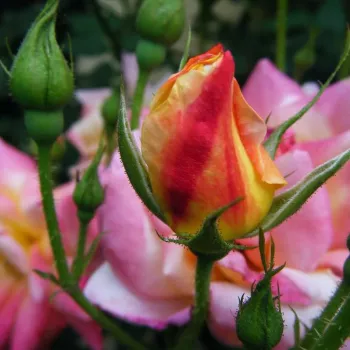
Bud and blooms shift from vivid yellow, orange and carmine red to softer peach, golden and copper shades; colour change continues through the flower’s life, with fiery red petal edges at full bloom. |
| Fragrance and aroma |
Mild yet noticeable scent with a fresh, crisp character rather than a heavy perfume; fragrance is more of a light, uplifting presence than a dominant feature, suiting mixed-use family gardens. |
| Hip characteristics |
Occasional small spherical hips, about 8–13 mm across, ripening to orange-red; largely ornamental and not produced in heavy quantities, so they do not usually dominate the plant’s appearance. |
| Resistance and winter hardiness |
Hardy to about −32 to −29 °C (USDA 4b, RHS H7), with medium disease resistance; benefits from good air movement and standard Irish rose care under blackspot, mildew and rust pressure. |
| Horticultural recommendations |
Best on well-drained, improved clay or loam in sun or light shade; space 150–250 cm depending on use, provide sturdy support, water in drought, and prune moderately to renew flowering wood. |
JOSEPH'S COAT offers long-season, ever-changing colour, reliable climbing coverage and years of own-root resilience, making it a thoughtful choice for Irish gardeners seeking a striking yet manageable rose.