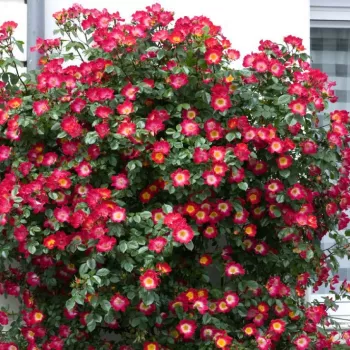
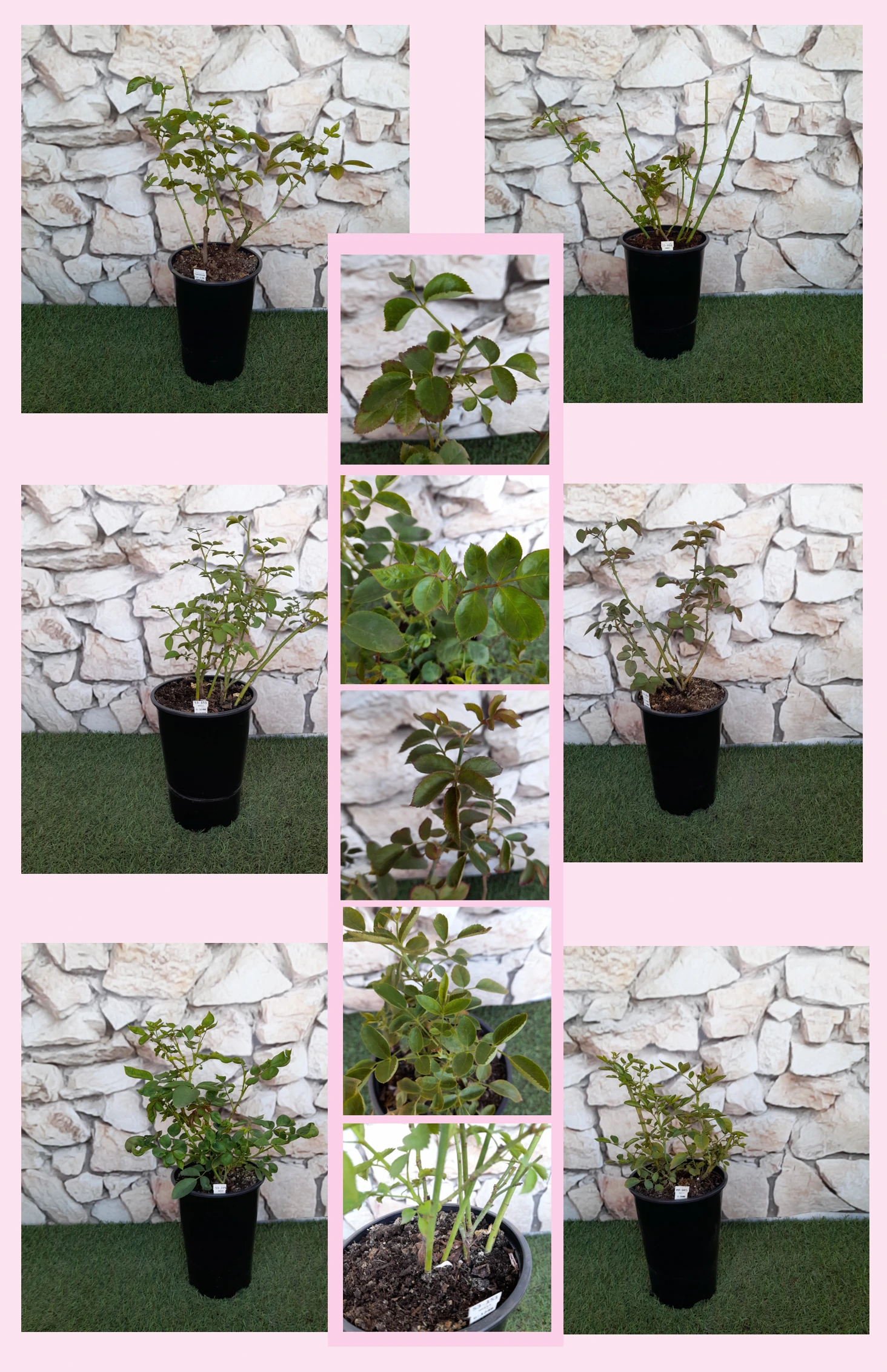
COCTAIL® – red-yellow park rose - Meilland
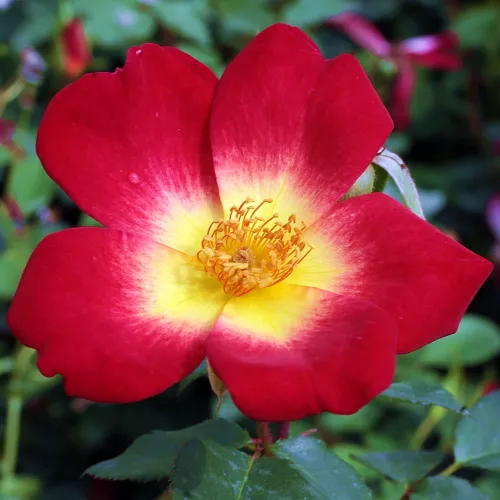
If You enjoy soft raindrops on a short stroll outdoors, COCTAIL® brings that same easy, cheerful contentment into a small Irish front garden. Its vivid red-and-gold single blooms feel instantly playful, lighting up cottage-style borders and terraced-house railings while remaining reassuringly simple to look after. This own-root Meilland classic settles in steadily, then offers years of dependable structure and colour with minimal fuss. Well-suited to breezy, damp Irish weather and heavier soils, it thrives where summers are cooler and unfussy plants are most appreciated. Over time it forms a medium-height, upright framework that is ideal for gentle training on fences or supports, creating an inviting, slightly informal backdrop for daily life. With open, easily reached stamens, its flowers are naturally welcoming to visiting bees, so each flush feels alive and subtly dynamic. Year by year the own-root base matures, supporting healthy renewal of flowering shoots and preserving the rose’s character season after season. Expect a clear development: solid rooting in year one, more generous shoots in year two, and a fully rounded ornamental presence by year three, giving long-lived, quietly reliable pleasure in a family garden.
Usage options
| Target area | Reasoning |
|---|
| Front garden climber on railings or low trellis |
COCTAIL®’s upright habit and 200–300 cm height make it perfect for training along modest Dublin terrace railings or a low trellis, giving strong colour without overwhelming the space. Own-root growth ensures it copes well with pruning and reshaping over time for beginners. |
| Cottage-style mixed border feature |
The vivid red-and-yellow single flowers sit beautifully with informal perennials, echoing a relaxed Irish cottage look while remaining easy to manage. Reliable remontant flowering through the short summer keeps borders lively without complicated deadheading routines for hobby-gardeners. |
| Light climber on pergola or arch |
Trained over a pergola, its clusters of small, self-cleaning blooms create a cheerful canopy that rarely needs more than seasonal tying-in and a tidy. Own-root stamina supports a long-lived framework, ideal for family gardens where permanence matters for homeowners. |
| Screening and informal flowering hedge |
Dense, glossy foliage and good height allow COCTAIL® to form a soft, flowering screen along boundaries. Spacing at 125–140 cm gives a loose hedge that filters views while attracting bees, suiting front gardens that favour privacy without high-maintenance clipping for urban-families. |
| Pollinator-friendly focal point near seating |
The open, single blooms with accessible stamens are particularly attractive to bees, adding subtle movement and life around a bench or patio. Continuous flushes of flowers give gentle seasonal interest rather than a single, short show, supporting nature-oriented bee-lovers. |
| Own-root long-term structure in small family gardens |
As an own-root shrub, COCTAIL® regenerates reliably from the base, maintaining its true variety even after hard pruning or winter damage. This underpins a long lifespan and steady ornamental value, ideal where one rose must earn its place for years for practical-gardeners. |
| Training against sunny walls and fences |
With good heat tolerance and remontant flowering, COCTAIL® performs well on warm walls, given watering in long dry spells and decent drainage in heavy Irish clay. This makes it a robust choice for exposed, sun-baked boundaries often found in suburban plots for busy-owners. |
| Large container on sheltered terrace or balcony |
In a 40–50 litre or larger pot with free-draining compost, COCTAIL® offers an upright, colourful presence for small paved spaces. Self-cleaning blooms and moderate maintenance make it manageable for those with limited time who still want a vibrant, long-lived rose for city-dwellers. |
Styling ideas
- Cottage-Glow – Combine COCTAIL® with gaura and dwarf Michaelmas daisies for an airy, pink-white haze beneath the red-and-yellow blooms – ideal for romantic cottage borders for nature-lovers.
- Terrace-Charm – Train it along simple metal railings with low lavender and thyme at the base to soften hard lines – perfect for compact Dublin front gardens seeking year-round structure.
- Family-Arch – Let COCTAIL® climb a wooden arch, underplanted with pastel geraniums, creating a playful, walk-through entrance that children and adults enjoy daily.
- Park-Edge – Use as a loose, flowering hedge with variegated weigela at intervals to echo the rose’s vivid tones – suited to larger plots wanting gentle screening and seasonal colour.
- Bee-Path – Line a garden path with spaced COCTAIL® shrubs interplanted with alliums and salvias to enhance pollinator activity along your everyday route to the door.
Technical cultivar profile
| Parameter | Data |
|---|
| Name and registration |
Trade name COCTAIL®, registered as MEImick, ARS exhibition name ‘Cocktail’; park / shrub rose used as an ornamental climber, floribunda-shrub type suitable for supports and free-standing training. |
| Origin and breeding |
Bred by Francis Meilland, Meilland International, France, from (Independence × Orange Triumph) × Phyllis Bide; introduced 1957 and still widely grown as a dependable, time-tested classic shrub. |
| Awards and recognition |
Highly decorated: Rome certificate 1956, Paris–Bagatelle 1st prize 1957, Orléans Gold Medal 1960; inducted into the WFRS Hall of Fame in 2015 as the world’s 16th “World’s Favourite Rose”. |
| Growth and structural characteristics |
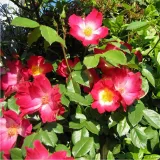
Vigorous shrub to 200–300 cm high and 120–180 cm wide, upright and well-branched with dense, glossy dark green foliage; self-cleaning spent blooms and densely thorned stems, good as a light climber. |
| Flower morphology |
Single, flat flowers with 5–12 petals, small (1–4 cm) yet produced in generous clusters; remontant with a strong first flush and lighter repeat, providing ongoing seasonal colour in average summers. |
| Colour data and phenology |
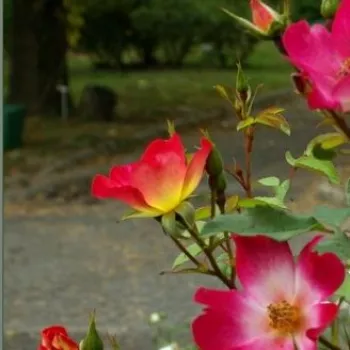
Scarlet red petals with a sharply contrasting golden-yellow eye; ARS code RB, RHS 46A outer and 13C inner, colours softening to salmon and creamy lemon tones as blooms age and in strong sunlight. |
| Fragrance and aroma |
Fragrance is very weak and barely noticeable, with a fresh, lively character when detected; chosen primarily for its visual impact and garden presence rather than for strong perfume or cut-flower use. |
| Hip characteristics |
Produces moderate numbers of small, spherical red hips, about 7–13 mm in diameter; decorative in autumn without becoming dominant, adding a gentle wildlife-friendly element to established plantings. |
| Resistance and winter hardiness |
Hardy to about −26 to −23 °C (H7, USDA 5b, Swedish zone 4); tolerates heat with watering in prolonged drought; disease resistance moderate, so occasional preventive care is advisable in damp seasons. |
| Horticultural recommendations |
Best in well-drained soil, including improved heavy Irish clay; suitable for full sun or partial shade, with spacing from 125–210 cm; support as a light climber or grow freely as a medium-tall shrub. |
COCTAIL® offers vivid red-and-yellow, self-cleaning blooms, pollinator-friendly single flowers and long-lived own-root reliability, making it a thoughtful choice for relaxed Irish family gardens and small urban fronts.