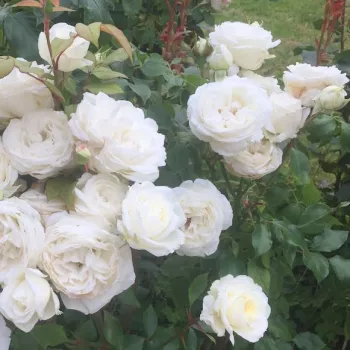
CLAUS DALBY™ – cream-white hybrid tea rose - Olesen
Imagine stepping outside after gentle rain into creamy soft light, where tall, elegant blooms glow against glossy foliage and cope calmly with Ireland’s damp, changeable summers and frequent showers. CLAUS DALBY™ is bred as a refined cottage hybrid tea you can enjoy without fuss: plant it once, then simply watch a graceful, bushy structure evolve year by year, with own‑root vigour supporting a genuinely long lifespan. The large, exhibition‑style flowers open in classic high‑centred form, perfect for cutting, and release a strong, honeyed fragrance that drifts along a path or into your sitting room. With thoughtful spacing and basic care for drainage on heavier soils, this variety settles in reliably and builds from first‑year roots to second‑year shoots and, by the third year, full, luminous ornamental value that feels both modern and gently romantic.
Usage options
| Target area |
Reasoning |
| Front garden focal shrub by the path |
Its upright, bushy habit and large, high‑centred blooms create a clear visual focus beside a doorway or garden path, while the strong honey-like scent greets everyone who passes, making it ideal for fragrance lovers and design-conscious homeowners. |
| Small rose bed in a family garden |
Planted at the recommended spacing, it forms a coherent, medium-height bed where the cream‑white flowers read as one calm block of colour, and own‑root resilience offers a long-lived feature with light maintenance for busy families. |
| Cutting patch for home bouquets |
The long, straight stems and exhibition-style flowers are tailored to vases, giving you reliable, scented stems for the house all summer, with repeated flushes meaning you can cut freely without sacrificing display, suiting creative flower‑arranging enthusiasts. |
| Specimen rose in a mixed border |
In a cottage-style or terraced-house border, its refined flower form and dark glossy foliage stand out against looser perennials, and the cream-white colour pairs gently with pastels, appealing to cottage‑garden and soft‑colour gardeners. |
| Large container on a sunny patio |
In a 40–50 litre or larger container with good drainage, its moderate size and repeat flowering give a long season of interest close to seating, while the strong fragrance is easy to enjoy at nose level, perfect for balcony and patio-focused owners. |
| Feature rose for Irish cottage gardens |
The restrained, warm white colouring and classic form echo traditional cottage roses yet flower repeatedly in our cool, moist climate with frequent showers, creating a timeless look that suits romantically inclined rural and village‑edge residents. |
| Low informal hedge along a front boundary |
At around a metre high with dense foliage, this variety knits into a soft, flowering hedge when planted at hedge spacing; own‑root growth helps it recover from occasional knocks or pruning, suiting practical yet style-aware front‑garden owners. |
| Long-term investment planting in family gardens |
Although it benefits from moderate care, its bushy structure, own-root durability and consistent flower form make it a satisfying, enduring feature that matures steadily over several seasons, ideal for patient, value-conscious garden beginners. |
Styling ideas
- COTTAGE RIBBON – Line a front path with staggered plants, underplanting with lavender and hardy geraniums for a soft cottage look – for lovers of romantic, gently structured gardens
- SOFT MONOCHROME – Combine with white foxgloves, white astrantia and silver foliage plants to emphasise the cream-white blooms – for fans of calm, low-clutter colour schemes
- EVENING PATIO – Position a large pot near seating with soft grasses and pale pink diascia nearby so flowers catch evening light – for people who unwind outdoors after work
- ELEGANT CUTTING – Dedicate a row in a veg or side garden with easy-access paths to harvest long, scented stems – for home florists who enjoy arranging their own bouquets
- TEXTURED BACKDROP – Plant against dwarf conifers and low evergreen shrubs so the glossy foliage and blooms stand out clearly – for design-minded gardeners who like year-round structure
Technical cultivar profile
| Parameter |
Data |
| Name and registration |
Hybrid tea rose, collection Hybrid Tea POULSEN®, registered as POUlht009, marketed as Claus Dalby™ Hybrid Tea POULSEN® POUlht009, ARS exhibition name Serenity, commercial group Rós taehibride. |
| Origin and breeding |
Bred by Mogens Nyegaard Olesen, Poulsen Roser A/S, Denmark, from unnamed seedlings; breeding year 2006, registered 2013 under EU PBR 2013/2166, introduced commercially after 2013 by Poulsen Roser A/S. |
| Awards and recognition |
Decorated in multiple European trials: Tokyo Gold Medal for fragrance and Silver Medal Category I in 2015, Nantes Audience Award for fragrance 2015, Baden-Baden Silver Medal 2015, Paris Certificate of Merit 2015. |
| Growth and structural characteristics |
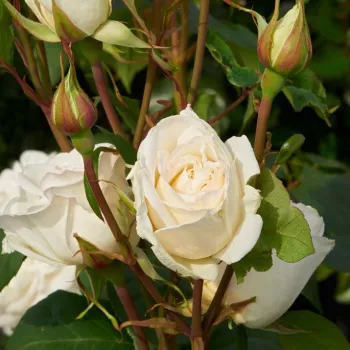
Bushy, medium-height shrub around 85–115 cm tall and 65–95 cm wide, with dense, dark green, glossy foliage and moderate prickles; self-cleaning is weak, so spent blooms may need occasional deadheading by hand. |
| Flower morphology |
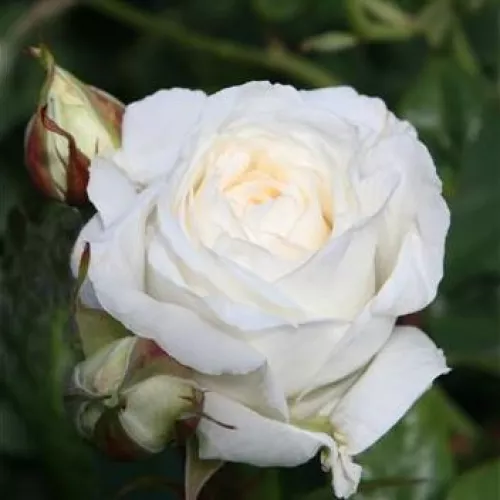
Hybrid tea type with solitary, high-centred, pointed buds, very full flowers with over 40 petals, large 7–10 cm blooms; remontant habit with generous repeat flowering providing a plentiful second flush in suitable conditions. |
| Colour data and phenology |
Cream-white petals, ARS code Wh; RHS 155C outer, 155D inner; buds pale ivory with buttery-yellow tip, opening to soft cream that lightens towards almost snow-white while retaining a subtle warm undertone as flowers age gracefully. |
| Fragrance and aroma |
Strong, long-lasting scent with a honey-like character, particularly noticeable in still, humid air; bred and awarded specifically for fragrance performance, making it suitable for gardens where perfume is a key design priority. |
| Hip characteristics |
Rose hip production is limited because of the very double flowers; where set, hips are spherical, 12–16 mm across, and orange-red, appearing only occasionally and not considered a major ornamental feature. |
| Resistance and winter hardiness |
Rated hardy to approximately –21 to –18 °C, equivalent to RHS H7, Swedish zone 3 and USDA zone 6b; disease tolerance is moderate for powdery mildew, black spot and rust, sometimes needing plant protection under high pressure. |
| Horticultural recommendations |
Best in sunny sites with well-drained soil; prefers 55 cm spacing in beds and 50 cm in hedges; suitable for containers, beds, cutting and specimen use, with moderate maintenance including occasional deadheading and preventive care. |
CLAUS DALBY™ offers elegant cream-white, high-centred blooms, award-winning fragrance and durable own-root growth for a long-lived, easy-care feature rose you may wish to add to your garden plans.