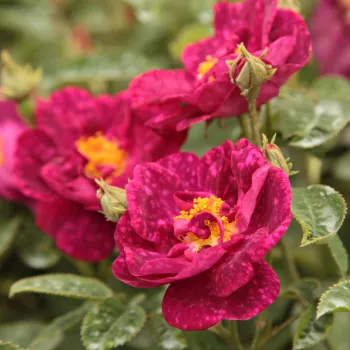
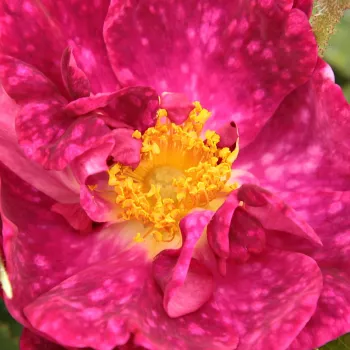
ALAIN BLANCHARD – crimson-red historical Gallica rose
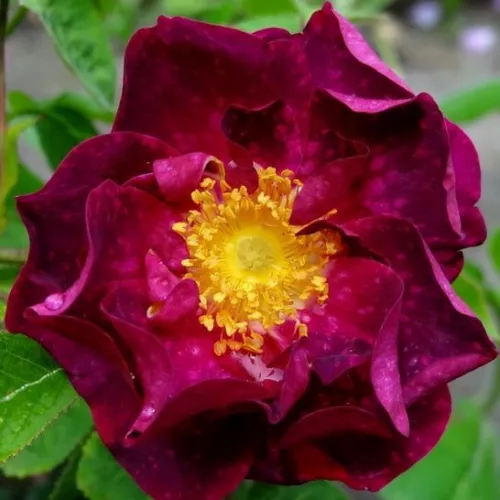
Step into a corner of living history with the richly marbled ALAIN BLANCHARD, a romantic Gallica shrub that brings a mood of green, soft light and quiet contentment to Irish cottage borders and Dublin front gardens. Its once-a-year summer display of speckled crimson, mauve and pink feels like a gentle festival in the rain, with single, open blooms that invite bees and hoverflies to forage. The strong, spicy-fruity fragrance drifts on damp air after showers, while the bushy, upright habit stays naturally tidy in everyday family life. On its own roots, this shrub settles in steadily and offers reassuring long-term stability with minimal fuss. Plant once, then let the deep-rooting habit quietly extend the rose’s useful lifespan. In heavier Irish soils it appreciates a touch of drainage improvement so it can ride out wet, windy spells with calm, resilient grace.
Usage options
| Target area | Reasoning |
|---|
| Cottage-style mixed flowerbed |
A bushy, 120–160 cm shrub with moderately dense, olive-matt foliage makes a charming anchor for a cottage-style border, weaving its historic, marbled crimson flowers through perennials like catmint and larkspur for a soft, storybook look – ideal for the romantic gardener. |
| Scented garden corner |
The strong, long-lasting spicy-fruity fragrance fills small spaces beautifully during its main summer flush, perfect by a seating area or path where you pass close enough to enjoy the perfume on warm or rainy evenings – perfect for the fragrance lover. |
| Low, informal flowering hedge |
With a spread and height both around 120–160 cm, this rose lines driveways or front boundaries as a relaxed hedge, offering seasonal privacy, historic charm and modest maintenance thanks to sparse thorns and medium self-cleaning – reassuring for the family homeowner. |
| Pollinator-friendly wildlife strip |
The simple, open, 5–12-petalled flowers with easily reached stamens are highly attractive to bees and other pollinators, supporting garden biodiversity while still looking ornamental and refined in small city plots – rewarding for the nature-focused buyer. |
| Feature shrub in a small front garden |
As a specimen planted at about 200 cm spacing, its distinctive marbled crimson and pink blooms create a focal point that looks thoughtfully designed with very little effort, especially when underplanted with low perennials for a lived-in, welcoming feel – ideal for the busy urban owner. |
| Part-shade side garden |
This historical Gallica tolerates partial shade, so it performs in those in-between spots beside walls or between houses, where many roses struggle, still giving good colour and scent during its bloom period – reassuring for the small-garden gardener. |
| Long-term garden investment planting |
As an own-root shrub, it regenerates from its base rather than relying on a graft, helping it recover from winter damage and keep its character for many years with moderate care, suiting those who plant once and enjoy for decades – appealing to the long-term planner. |
| Weather-resilient Irish family garden border |
With moderate disease resistance and proven hardiness down to about -25 °C, this rose copes well with cool, wet conditions and only occasional plant protection, fitting into typical Irish family gardens where summers are short yet valued – ideal for the practical beginner. |
Styling ideas
- Cottage-Drift – combine with catmint and larkspur for a loose, romantic strip along a path, letting the marbled crimson flowers float above soft blues and lilacs – for relaxed, story-loving gardeners.
- Frontage-Focus – plant a single specimen by the gate, framed with low box or lavender, so its summer scent and colour greet you and visitors alike – for house-proud city and village homeowners.
- Heritage-Hedge – repeat at 110–120 cm intervals with clumps of Rudbeckia between plants to form a low hedge that glows from midsummer into autumn – for those wanting gentle structure without harsh lines.
- Shady-Nook – tuck the shrub into a part-shade side bed, underplant with ferns and hostas so the vivid blooms and fragrance contrast with cool foliage – for gardeners making the most of awkward spaces.
- Wildlife-Ribbon – run a loose line of plants along a fence, infill with pollinator-friendly perennials and leave spent hips for autumn colour and birds – for nature-oriented families and schools.
Technical cultivar profile
| Characteristic | Data |
|---|
| Name and registration |
Historic Gallica shrub rose marketed as ALAIN BLANCHARD – crimson-red historical Gallica rose. Trade name: Alain Blanchard Historic rose Coquerel & Vibert. Exhibition classes: shrub rose; historic rose. Unregistered variety. |
| Origin and breeding |
Gallica Hybrid bred in France around 1829 by Coquerel and Jean-Pierre Vibert, from Rosa centifolia × Rosa gallica. Introduced commercially in 1839 as a historical garden rose, cherished in heritage collections. |
| Awards and recognition |
Recognised in American Rose Society shows as Dowager Rose Queen at Seattle Rose Society Show in 1999 and at Grosse Pointe Rose Society Show in 2001, reflecting enduring exhibition and collector appeal. |
| Growth and structural characteristics |
Vigorous, bushy shrub 120–160 cm high and 100–160 cm wide, with moderately dense, olive-green matt foliage and sparse prickles. Medium self-cleaning; some dead blooms may need removing for neatness. |
| Flower morphology |
Single, medium-sized blooms 4–7 cm across, usually solitary. Cup-shaped at opening then flattening, with 5–12 petals exposing central stamens. Non-remontant, flowering once in an abundant early-summer flush. |
| Colour data and phenology |
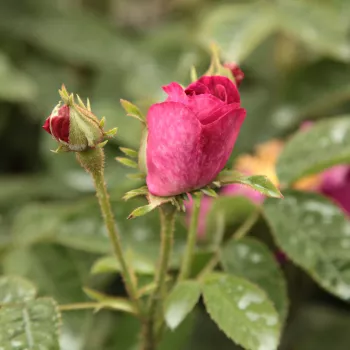
Closed buds dark crimson with silvery shimmer; freshly opened flowers vivid crimson red with irregular pale pink spots. Overall effect rich crimson-red with whitish-pink speckling; colour lightens and blurs in strong sun. |
| Fragrance and aroma |
Strong, long-lasting perfume with a spicy, fruity character typical of old Gallica roses. Best appreciated near seating or paths, especially in still, humid weather when the scent hangs in the air. |
| Hip characteristics |
Moderate set of spherical orange-red hips 16–24 mm in diameter. Hips can be attractive in autumn and winter on less heavily pruned plants, adding seasonal interest and potential wildlife value. |
| Resistance and winter hardiness |
Hardy to approximately -26 °C (RHS H7, USDA 5b, Swedish Zone 4). Moderate resistance to powdery mildew, black spot and rust; tolerates heat and moderate drought but may weaken in extended hot spells. |
| Horticultural recommendations |
Best in well-drained but moisture-retentive soil; improve heavy clay with compost and grit. Space 110–200 cm depending on use. Suitable for partial shade. Occasional plant protection and light pruning maintain health and form. |
ALAIN BLANCHARD offers romantic historic charm, a strong spicy-fruity scent and pollinator-friendly single blooms on a resilient own-root shrub, making it a thoughtful long-term choice for Irish gardens you may wish to consider.